
In the world of digital creation, many developers and creators start with a single project. Some begin by building a mobile app. Others create websites, tools, or digital products. The goal is often simple: create something useful and eventually turn it into a source of income.
However, many projects fail not because the idea was bad, but because there was no system behind the work.
After experimenting with different projects — including mobile games, websites, and automation tools — I realized that sustainable digital income rarely comes from a single project. Instead, it comes from building an ecosystem.
Over time, I developed a simple framework that guides how I approach digital projects:
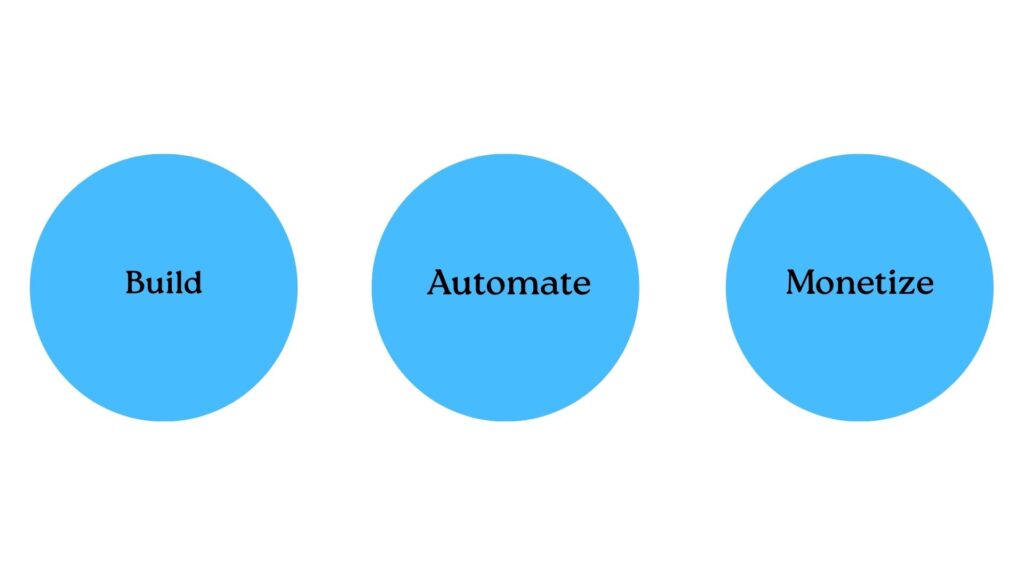
Build → Automate → Monetize
This system helps transform small experiments into scalable digital assets.
In this article, I will explain how this system works and how developers and creators can apply it to their own projects.
The Problem With Random Digital Projects
Many developers start projects randomly.
They might build an app today, start a website tomorrow, and experiment with a tool next week. While experimentation is useful, working without a structure often leads to unfinished projects or scattered efforts.
Without a system, it becomes difficult to scale.
Time is limited, and managing everything manually quickly becomes overwhelming.
This is where the Build → Automate → Monetize framework becomes useful.
Instead of approaching projects randomly, this model organizes digital work into three clear stages.
Stage 1: Build – Creating the Digital Asset
The first stage is building something valuable.
This could be:
• a mobile game
• a productivity app
• a website
• a digital tool
• a developer resource
The key idea is to create something that solves a problem or provides entertainment.
For developers, building is usually the most natural step. Writing code, designing systems, and launching projects are skills many developers enjoy.
However, building alone is not enough.
A digital product without visibility or growth strategy often remains invisible.
This is why the next stage becomes important.
What I Focus On When Building
When building digital projects, I try to keep the scope realistic.
Instead of trying to build complex systems immediately, I focus on smaller projects that can be completed and released quickly.
Examples of digital assets include:
• simple mobile games
• small productivity apps
• developer tools
• educational websites
The goal is not perfection.
The goal is shipping real projects.
Every published project becomes an asset that can grow over time.
[MY GAME DEVELOPMENT EXPERIENCE: THE INDIE DEVELOPER TRAP] “When I first stepped into game development, I fell straight into the classic indie trap: attempting to build a massive, realistic 3D car racing game entirely on my own. I spent months fighting with vehicle physics and manually sculpting heavy environments, thinking that high-end graphics were the only path to success.The Reality Check: The project turned into an unoptimized, bloated asset that severely drained mobile device memory and suffered from endless performance bottlenecks. Ironically, a much simpler math quiz game I programmed later in half the time vastly outperformed that complex racing game in organic downloads. This taught me a priceless lesson: your early goal as a solo developer shouldn’t be perfection. It should be shipping a Minimum Viable Product (MVP) to master the full deployment loop and understand how real users interact with your code.”
Publishing projects also provides valuable feedback from real users.
Stage 2: Automate – Building Systems That Work for You
Once a project exists, the next step is automation.
Automation transforms individual projects into scalable systems.
Without automation, many tasks must be done manually.
For example:
• publishing content
• responding to customers
• sharing posts on social media
• tracking analytics
• managing leads
Doing these tasks manually can consume enormous amounts of time.
Automation tools allow developers to build systems that perform these tasks automatically.
Why Automation Is Powerful
Automation allows creators to focus on high-value work.
Instead of spending hours on repetitive tasks, systems can handle them in the background.
For example, automation workflows can:
• publish blog posts to social media automatically
• send notifications when users submit forms
• generate reports from analytics data
• connect different services together
One powerful automation tool is n8n, which allows developers to create workflows that connect multiple services through APIs.
[MY n8n AUTOMATION SYSTEM: OPERATING AT AGENCY SCALE AS A SOLO DEV] “To manage my mobile games, technical blog, and business operations without burning out, I built a custom automation system that functions as my backend team. I deployed a self-hosted instance of n8n using Docker on a Hostinger VPS for a completely fixed infrastructure cost of $17/month, bypassing Zapier’s expensive per-task pricing models. By running it on my own virtual private server, all my critical API keys and sensitive tokens remain secure within my own infrastructure.Every 30 minutes, an automated workflow triggers to scan a centralized Google Sheets content calendar. It filters due rows, executes internal JSON mapping and data cleanup, and pushes marketing payloads via native APIs directly to Twitter/X, LinkedIn, and Telegram channels. This pipeline continuously drives organic visibility to my app updates and devlogs in the background, allowing me to maintain a massive digital presence while keeping my focus 100% on writing clean code and developing core application features.”
By building automation workflows, developers create digital infrastructure that supports their projects.
Real Examples of Automation Systems
Some automation workflows that digital creators often build include:
Content Distribution Automation
Publishing an article automatically triggers posts on multiple platforms.
Customer Response Automation
Incoming messages are categorized and answered automatically.
Analytics Reporting
Daily reports are generated automatically and sent to dashboards.
Lead Collection Systems
New leads are captured and stored automatically.
These systems reduce manual work while improving efficiency.
Over time, automation becomes the backbone of a digital ecosystem.
Stage 3: Monetize – Turning Digital Assets Into Revenue
After building and automating projects, the final stage is monetization.
Many creators attempt to monetize too early.
However, monetization works best when a project already has:
• users
• content
• engagement
Once these elements exist, multiple revenue streams become possible.
Monetization Methods for Developers
Different types of digital projects support different monetization strategies.
Common revenue sources include:
Advertising
Platforms like AdMob and AdSense allow developers to earn revenue from traffic and app usage.
Digital Products
Developers can sell assets, templates, or tools.
Services
Developers may offer consulting, development services, or automation setup.
Subscriptions
Some tools generate recurring revenue through subscription models.
Combining multiple revenue streams often creates the most stable income.
[MY MONETIZATION EXPERIENCE: ENGINEERING ASO FOR HIGH-VALUE MARKETS] “I learned a brutal lesson regarding revenue generation when I launched an early app named ‘Fast Separator Game’. It had zero search optimization and a generic icon, leading the storefront algorithms to push it primarily toward low-payout geographic regions. The disappointing result was making less than $3 from over 5,000 organic downloads.
That failure forced me to completely master App Store Optimization (ASO) and regional revenue dynamics. I executed a total storefront overhaul, rebranding the project to ‘Neon Divider: Physics Puzzle’, upgrading the metadata with targeted English keywords, and designing a high-contrast, vibrant icon. Immediately, my store click-through rate (CTR) shot up, and the app began ranking in high-value Tier 1 markets like the US and Europe, drastically lifting my eCPM.
Furthermore, I restructured how the app generated revenue; I replaced invasive, forced banner ads with Optional Rewarded Ads. By utilizing a centralized, modular Ads Manager script within the code, I ensured that ads only triggered during natural gameplay breaks—like a game-over screen. This approach heavily protected user retention while maximizing my overall ad impressions and sustainability.”
Why Most Developers Struggle With Monetization
Many developers focus heavily on the building phase but ignore automation and monetization.
This leads to projects that function technically but never grow.
Successful digital creators often think in systems rather than isolated projects.
Each stage supports the others.
Build creates assets.
Automation scales those assets.
Monetization turns them into revenue.
The Power of Digital Ecosystems
One important realization I had is that digital projects work better when connected together.
Instead of treating each project as separate, they can support each other.
For example:
• a website attracts traffic
• the website promotes mobile apps
• apps generate advertising revenue
• automation tools manage workflows
This interconnected structure creates a digital ecosystem.
When one part grows, it benefits the others.
Example of a Digital Creator System
A developer might build a system like this:
Mobile games generate AdMob revenue.
A blog publishes tutorials and attracts search traffic.
Automation tools manage content distribution.
Digital tools or assets are offered for download.
Services are offered through the website.
This structure creates multiple revenue streams.
Even if one source slows down, others may continue growing.
Why Long-Term Thinking Matters
Digital income rarely happens instantly.
Most successful creators build their systems gradually.
The early stage often involves experimentation and learning.
Over time, projects improve.
Traffic grows.
Automation becomes more efficient.
Revenue increases slowly but steadily.
The most important factor is persistence.
Developers who continue building, improving, and learning gradually create stronger systems.
The Philosophy Behind Net4profit
The concept behind the Build → Automate → Monetize system reflects a broader philosophy.
Instead of chasing quick income opportunities, the focus is on building sustainable digital infrastructure.
The idea is simple:
Create useful things.
Build systems around them.
Allow those systems to generate income over time.
This philosophy encourages long-term thinking rather than short-term experiments.
[MY PERSONAL VISION: BUILDING LONG-TERM INFRASTRUCTURE THAT COMPOUNDS] “This framework directly reflects how I run and scale my digital operations today. I have completely moved away from the volatile loop of chasing isolated, random ideas. Instead, I incorporated my business, PPMD GROUP LTD, to act as a structured holding corporate portfolio for all my core software developments.
Currently, my vision is focused on execution across two major fronts. First, I am preparing to launch a commercial storefront engineered around high-ticket, premium n8n automation templates with price points ranging from $199 to $999 to help modern businesses streamline their operations. Second, I am actively developing a logistics platform built on robust, native architecture (Swift and Kotlin) designed to solve supply chain bottlenecks by cleanly connecting factories, truck drivers, and end customers. To me, independent development is no longer about just launching small apps—it is about engineering permanent, secure digital assets that compound in asset value and operational efficiency year after year.”
Advice for Developers Starting Today
For developers who want to build sustainable digital projects, a few simple principles can make a big difference.
Start small.
Finish projects.
Automate repetitive tasks.
Analyze data regularly.
Think in systems rather than isolated products.
Most importantly, be patient.
Digital ecosystems take time to grow.
But once they are built, they can generate value for many years.
Final Thoughts
The digital world offers incredible opportunities for developers and creators. With the right approach, small projects can evolve into powerful systems that generate long-term income.
The Build → Automate → Monetize framework provides a simple structure for turning ideas into sustainable digital assets.
Building creates the foundation.
Automation enables scale.
Monetization transforms projects into revenue streams.
Developers who combine these three stages effectively can move beyond individual projects and begin building entire digital ecosystems.
Over time, these ecosystems become more than just experiments.
They become platforms for creativity, innovation, and sustainable income in the digital age.